In the aggregate and mining industries, impact crushers rely on high-velocity mechanical energy to fracture rock rather than slow hydraulic compression. However, confusion often arises when comparing the core wear parts used in different impact crusher configurations—specifically HSI Blow Bars versus VSI Rotor Tips. Today, we explain what a blow bar is, how it functions in Horizontal Shaft Impactors (HSI), and how HSI wear components compare with Vertical Shaft Impactor (VSI) rotor wear parts.
Understanding the Function of a Crusher Blow Bar
A blow bar is a heavy slab of specialized wear-resistant alloy installed directly into the rotating rotor of a Horizontal Shaft Impactor (HSI). As the HSI rotor spins on a horizontal axle, the protruding blow bars strike incoming raw rock with massive kinetic force, shattering stone into smaller fragments before hurling material against apron plates.
- Primary Impact Zone: Blow bars take the initial, high-impact force of large feed stones entering the crushing chamber.
- Alloy Formulations: Typically cast from High-Manganese Steel, High-Chrome Alloy, or Martensitic Steel with Ceramic Inserts depending on feed material toughness and abrasion.
- Reversible Design: Most blow bars are engineered with symmetrical profiles allowing maintenance crews to flip worn bars and utilize both edges.
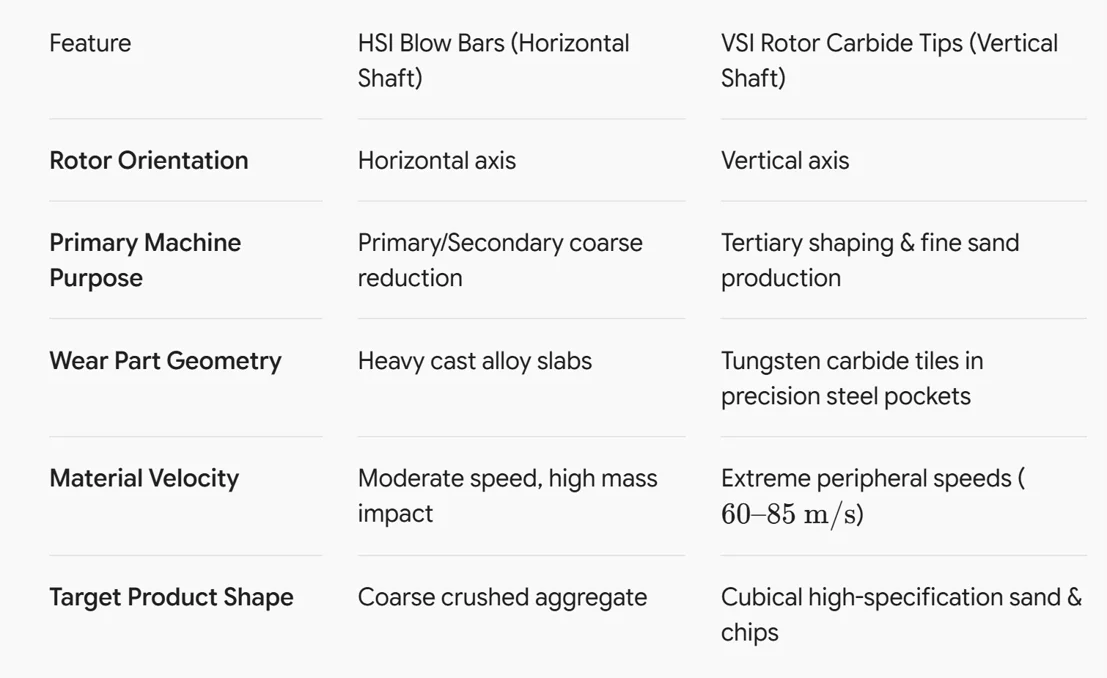
HSI Blow Bars vs. VSI Rotor Carbide Tips: What Is the Difference?
While both machines utilize impact force, HSI and VSI crushers serve distinct stages in aggregate processing:
Transitioning to Fine Shaping and Manufactured Sand
While HSI blow bars handle large stone reduction, downstream processing requires Vertical Shaft Impactors to achieve cubical aggregate shapes and consistent sand fineness modulus. In a VSI rotor, stone streams exit through high-speed rotor ports lined with tungsten carbide tips rather than heavy cast blow bars.
Equipping your VSI rotors with micro-grain tungsten carbide tips ensures precise material acceleration, lower wear cost per ton, and long operational service between maintenance shifts.
Discover High-Performance VSI Wear Solutions at MCT
Understanding the distinct roles of HSI and VSI wear components helps crushing plants select the ideal wear parts for each processing stage.
At MCT, we manufacture premium VSI rotor tungsten carbide tips, back-up tips, and internal rotor cavity plates designed for demanding sand and aggregate production. Explore our full lineup on our VSI Rotor Wear Parts Page or contact our technical sales team today to request expert guidance and pricing!