In many daily industrial conversations, the terms “tungsten” and “tungsten carbide” are often used interchangeably. However, they are two entirely different materials with distinct properties and applications.
Pure tungsten is a dense metallic element famous for its high melting point, making it widely used in electrical contacts and heating elements. On the other hand, when tungsten is combined with carbon, it becomes tungsten carbide. Thanks to this chemical combination, tungsten carbide achieves extreme hardness and wear resistance. This is exactly why tungsten carbide, rather than pure tungsten, is the go-to choice for manufacturing heavy-duty wear parts, such as cutting edges and VSI crusher rotor.
Choosing the right material can directly impact your equipment’s performance and service life. Today, we will break down what these two materials are and compare their core physical and mechanical properties in detail. For more specific differences, just read on!
What is Tungsten?
Tungsten, represented by the chemical symbol W, is a natural metallic element. It is most famous for its incredible heat resistance. In fact, it has the highest melting point of all known metals, reaching an impressive 3,422 °C (6,192 °F). Because it can withstand such extreme temperatures, pure tungsten is primarily used in heating elements, electrical contacts, and aerospace applications.
Apart from heat resistance, tungsten is remarkably dense, about 1.7 times heavier than lead and comparable to gold. However, pure polycrystalline tungsten has a significant limitation in industrial manufacturing: it is highly brittle. In its raw, uncombined state, it is difficult to machine and can easily break under heavy physical impact. For this reason, pure tungsten is rarely used on its own to manufacture heavy-duty wear parts.
What is Tungsten Carbide?
Tungsten carbide, often referred to simply as carbide, is a chemical compound made of equal parts of tungsten and carbon atoms. Unlike solid pure tungsten, tungsten carbide in its most basic form is actually a fine gray powder.
To create usable solid parts, this powder is mixed with a binder metal, such as cobalt. The mixture is then pressed into a specific shape and heated at extremely high temperatures, a process known as sintering. Thanks to the addition of carbon and the sintering process, tungsten carbide completely overcomes the brittleness of pure tungsten and becomes an entirely different material.
The most outstanding benefit of tungsten carbide is its extreme hardness, which is closely comparable to diamonds. Moreover, it is roughly three times stiffer than steel, twice as dense, and incredibly resistant to wear and abrasion.
These unique mechanical properties make tungsten carbide the ideal material for the most demanding industrial environments. For example, it is the primary material used to produce hardfacing materials, like carbide grits, to protect metal surfaces from rapid wear. It is also the core material for manufacturing heavy-duty equipment components, such as VSI crusher rotors, snow plow cutting edges, and road milling teeth, where maximum durability against constant impact and abrasion is strictly required.
Property Comparison Chart
To better understand why tungsten carbide is the preferred choice for heavy-duty wear parts, let’s look at a direct comparison of their core properties.
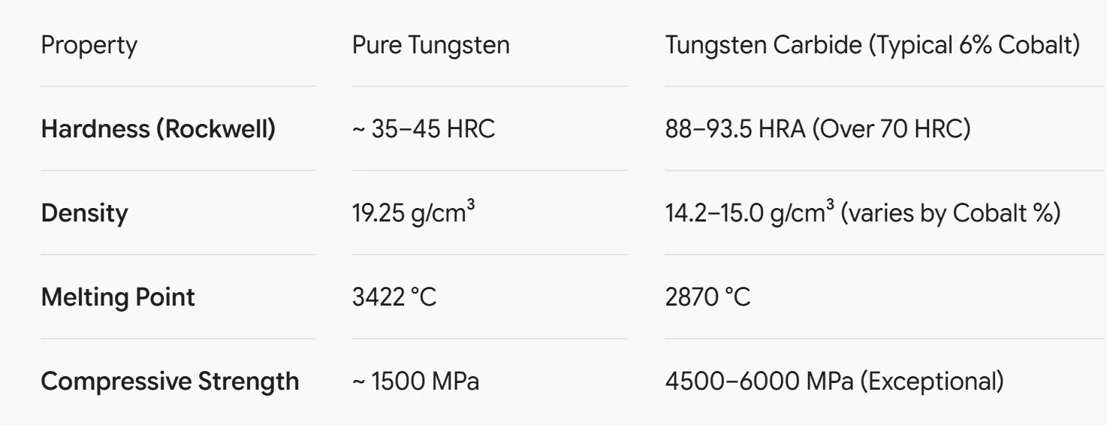
As you can see from the chart, these two materials behave very differently under stress.
First, tungsten carbide is significantly harder. While pure tungsten has a moderate hardness, tungsten carbide reaches well over 70 HRC. Thanks to this exceptional hardness, carbide parts can easily cut through asphalt, rocks, and icy roads without losing their shape or wearing out quickly.
Moreover, take a look at the compressive strength. Compressive strength basically measures how well a material can withstand being pushed, crushed, or squashed. Tungsten carbide offers a compressive strength of 4500 to 6000 MPa, which is roughly three to four times that of pure tungsten. This is exactly why tungsten carbide can survive the immense crushing forces inside a VSI crusher or the constant heavy pounding of road milling machines.
On the other hand, pure tungsten wins in density and melting point. It is heavier and can withstand extreme temperatures up to 3422 °C. However, for most ground-engaging tools and wear applications, melting at three thousand degrees is not the primary concern. Instead, the unbeatable combination of extreme hardness and high compressive strength makes tungsten carbide the ultimate winner for industrial wear parts.
Applications in Industry
Now that we’ve compared their core properties, let’s see how pure tungsten and tungsten carbide perform in the real world. Actually, cemented tungsten carbides make up 60% to 70% of the global tungsten usage, which shows its dominant position in heavy industries.
Pure Tungsten Applications
Because of its extreme heat resistance and great electrical conductivity, pure tungsten is ideal for specialized high-temperature environments rather than heavy-duty physical work. For instance, it is widely used as a non-consumable electrode in TIG welding and plasma cutting. Thanks to its high melting point, welders can safely heat the metal parts without the tungsten electrode melting away. Moreover, pure tungsten is applied as conductive ink for the inner circuitry of high-end medical and military ceramic circuit boards.
Tungsten Carbide Applications
As mentioned above, tungsten carbide completely overcomes the brittleness of pure tungsten. It provides outstanding hardness and extreme wear resistance. Therefore, it is applied wherever parts need to survive severe impact and abrasion. You can easily find it in mining, construction, road maintenance, and forestry industries. Specific applications include:
Hardfacing & Wear Protection
Tungsten carbide is frequently manufactured into carbide grits. These grits are applied to vulnerable metal surfaces through hardfacing services, adding an extremely durable protective layer to extend the lifespan of the equipment.
Aggregates & Quarries
Tungsten carbide is the core material for manufacturing heavy-duty crusher components. For example, VSI crusher wear parts, like rotors, heavily rely on tungsten carbide to withstand the massive and constant impact when crushing rocks and aggregates.
Road Maintenance & Construction
Thanks to its exceptional hardness, tungsten carbide is perfect for road maintenance equipment. Snow plow wear parts, including JOMA blades and carbide cutting edges, use it to scrape through hard ice without quick wear. Apart from snow removal, road milling teeth and grader blades also depend on carbide to cut through tough asphalt and gravel.
Forestry & Agriculture
Moreover, tungsten carbide is widely used to manufacture forestry and agricultural wear parts, such as mulcher teeth, allowing the equipment to grind wood and clear land efficiently.
MCT provides high-quality tungsten carbide wear parts to help you solve severe wear problems and extend your equipment’s service life. Whether you are looking for premium hardfacing materials like carbide grits, durable VSI crusher parts for aggregate production, or heavy-duty snow plow cutting edges for road maintenance, we’ve got you covered. Using the right carbide wear parts can minimize your machine downtime and save lots of money for your business.
At MCT, we specialize in premium hardfacing materials like carbide grits, durable VSI crusher parts for aggregate production, and heavy-duty snow plow cutting edges for road maintenance. Explore our technical carbide solutions or submit your drawing specifications to our metallurgy experts today for factory pricing!
Frequently Asked Questions (FAQ)
Is tungsten carbide stronger than tungsten?
Yes, tungsten carbide is generally stronger and much more durable for industrial use. Tungsten carbide is a compound created by combining tungsten with carbon. Thanks to this combination, the material achieves exceptional hardness, wear resistance, and an impressive elastic modulus that is second only to diamond.
However, when we talk about “strength,” we need to look at specific forces. Because both materials are brittle by nature, their tensile strength (resistance to being pulled apart) is relatively low. But just like a brick wall, they are incredibly strong in compression. Specifically, tungsten carbide boasts an exceptional compressive strength of around 4000–6900 MPa. Moreover, it retains this extreme strength even through severe temperature changes, making it the better choice for heavy-duty applications.
Is tungsten heavier than tungsten carbide?
Yes, pure tungsten is heavier. As we mentioned in the comparison chart, pure tungsten has a density of 19.25 g/cm³, which is comparable to gold. When tungsten is combined with carbon and binder metals (like cobalt) to create tungsten carbide, the overall density decreases to around 14.2–15.0 g/cm³. However, despite being slightly lighter, tungsten carbide is much harder and more wear-resistant.
Does tungsten carbide rust?
Tungsten carbide itself is highly resistant to rust and corrosion. However, the binder metal used in the manufacturing process, such as cobalt, can be susceptible to corrosion in extreme chemical environments. For most daily industrial applications, such as snow plow wear parts working in wet, icy, and salty conditions, tungsten carbide performs exceptionally well and will not rust like standard steel.
Can tungsten carbide be welded?
Because tungsten carbide is a very hard and brittle composite material, it cannot be welded directly using traditional welding methods like steel. Instead, carbide parts (like road milling teeth or grader blades) are usually brazed onto a softer steel body. In hardfacing applications, tungsten carbide grits are dropped into a molten weld pool to bond with the metal surface, providing a highly wear-resistant protective layer.